
Kent, in South East England, has one of the longest coastlines in the country, and being just 21 miles from France, in Dover, boasts a colourful maritime past. As well as being the Garden of England, which has long marched to the rhythm of the agricultural year, there is a rich legacy of cultural heritage within our many sites, monuments and in the very fabric of our buildings. Sometimes, we may rush past these treasures without a second glance or perhaps we just think them to be rather meaningless curiosities, but peep behind the evidence in front of your eyes, and you can usually discover a story deeply rooted in our past. Let’s have a look at just a few of them:
The Hugin Replica Viking Ship, Pegwell Bay, Kent
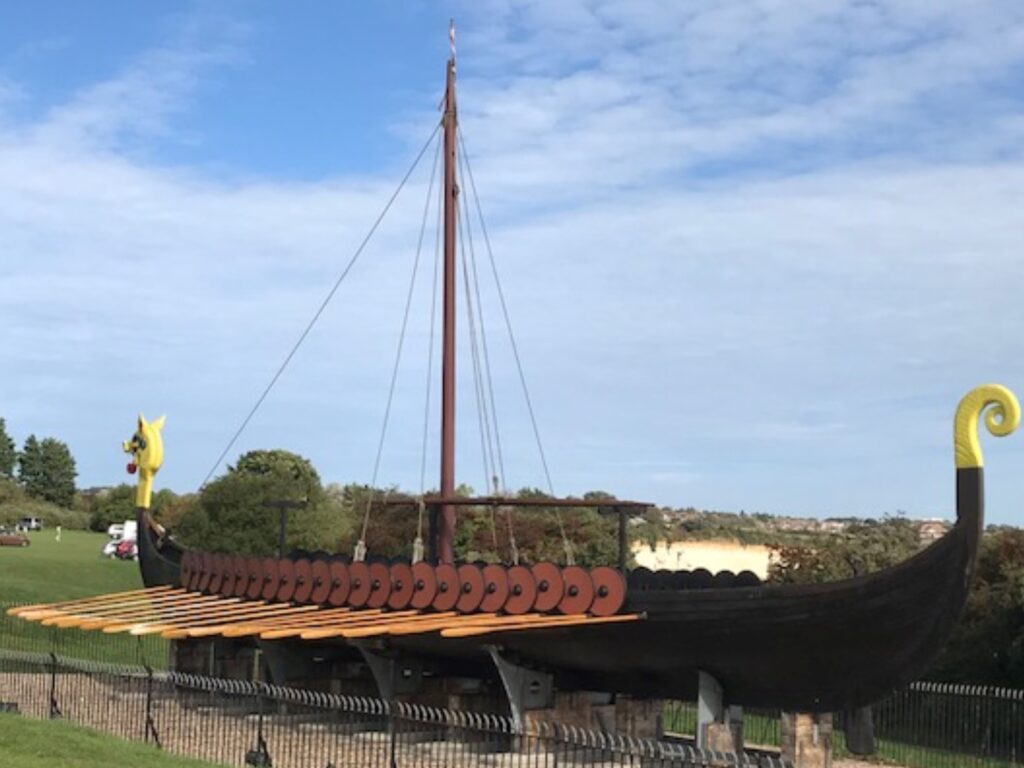
The Hugin is a reconstructed Norsemen (Viking) longship. It was a gift from the Danish government to commemorate the 1500th anniversary of the AD 449 migration from Jutland (modern day Denmark) to Kent, of Hengist and Horsa who became leaders of the Anglo Saxon invasion. They are remembered to this day in Kent’s insignia, the white horse, which is said to have featured on Hengist’s battle flag.
The boat was built in Denmark from where it was sailed by 53 Danes to England in 1949. It landed at Viking Bay in Kent, before being moved to its present site.
Ruckinge Churchyard - The Ransley Grave
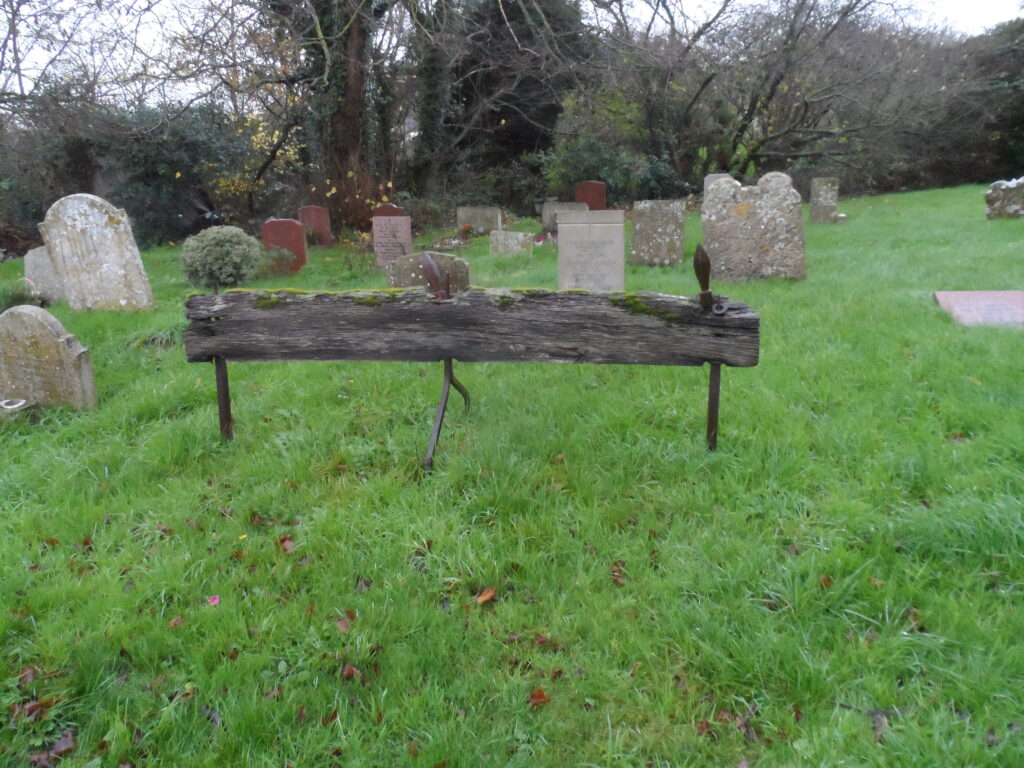
This is a graveboard, and once a common sight where families, who were unable or unwilling to supply the more usual headstone, but didn’t wish to see their family member’s last resting place go unmarked. Any inscription which might have been here has long since eroded in the strong winds of winter which blow in from Romney Marsh. However, records tell us that this is the resting place of James Ransley (died Christmas Day 1817) and some of his family members. The grave includes James the younger, and his brother, William Ransley, known locally as ‘ The Rascally Brothers’ – They were hanged in Penenden Heath, Maidstone in 1800. Their crimes included, smuggling, highway robbery, horse-theft and common assault. Their legacy continued with the advent of The Aldington Blues – a gang of smugglers, led by George Ransley (who was later captured and deported to Australia for his sins)!
Timeball Tower Deal
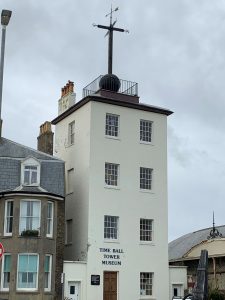
In the days of sail, Deal was an important Naval town, giving safe shelter to ships moored in the shallow waters of The Downs (Bordered by the Goodwin Sands – a series of sandbanks notorious for their wrecks, and known as ‘The Ship Swallowers’ )!
The Deal Boatmen made their living from carrying supplies ( it is suggested, beer, bread and women )! to the ships. As for the Timeball Tower, which from 1855, carried a timeball. This was linked to the Royal Observatory in Greenwich by electric telegraphy wires running alongside the railway line.
At 12.58 each day, the ball would rise to the top of the mast and at 1 p.m. precisely, a signal was sent from Greenwich to all timeballs (including Deal) and the ball would drop – allowing the ships at sea to check the accuracy of their chronometers – essential for accurate navigation. It ceased official operation in 1927. A project currently underway is restoring the Timeball Tower, and we look forward to seeing it in action once more.
The Whitstable Divers

Moving around to the north Kent coast and we come to Whitstable, most famous for its oysters, but there are several other firsts and achievements for which we can thank this small fishing town. The first passenger railway journey took place here in May 1830 along the Canterbury and Whitstable Line (affectionately known as the Crab & Winkle Line) – hauled by Stephenson’s Invicta engine, just beating the renowned Liverpool and Manchester Railway (and Stephenson’s Rocket) by 4 months !
But why would we see this curious statue by the harbour in front of the town’s swimming pool ? Well, tradition attributes the invention of early diving apparatus (with helmet and air supply) to a local pair of brothers, Charles and John Deane.
A lovely story tells us that John dramatically rescued some horses at a farm here by using the helmet from a suit of old armour in the house hallway with air being pumped in to the helmet supplied by a pump which had been used in hosing the fire ! If it could work in a smoke filled room, might it not work under water ? With the help of George Hall, who was a diver, using a diving bell, they developed a technique which was to change the diving industry.
Later John moved to Portsmouth in Hampshire where they discovered, and worked on the wonderful ‘Mary Rose’ – King Henry V111’s warship.
The Metamorphosis of Glaucus
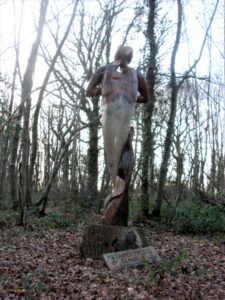
If you are driving along country roads from Folkestone towards Canterbury you might be surprised at what you may see in woodland, just near the side of the road. This is a wood carving by Daniel Hilton called "Metamorphosis of Glaucus". According to Greek mythology, Glaukus (Glaucus is the latin translation) was a fisherman who was transformed into a sea-god after eating a magic herb. It was believed that he would come to the rescue of mariners and fishermen in danger at sea, having, when mortal, earned his living from the sea. The sculptor, a local Kentish man is well known for his creative wood carving, and, perhaps especially for his work 'Tree Baby' which is a tree carving of a baby in the womb. A rather lovely gesture as the work gave a life to an old tree which otherwise would have just been cut down and destroyed.
Church Bell in Yew Tree in Barfreston
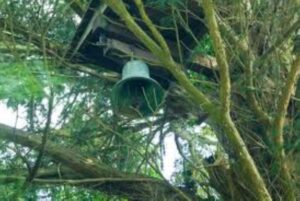
Finally, for the moment, I just wanted to share a picture of a bell – not in a church tower but in a yew tree in a church yard ! – This can be found at Barfeston’s little (but world-famous) church of St Nicholas not far from Canterbury or Dover. The church itself, which will be the subject of a further blog, is a simple but magnificent example of Norman (Romanesque) architecture with splendid carvings which share with us how our Medieval ancestors lived and worked to the rhythm of the agricultural year. Whilst it is quite usual to find a yew tree in a churchyard, it is perhaps unexpected to find the church bell housed within the tree. There it has been though for well over 100 years.
Creativity Travel offers guided tours throughout Kent and Sussex. Transportation can be by chauffeur driven car, minibus or coach, and, of course there are options for guided walking tours in some of our towns and cities.
Where roads are narrow, and the hidden gems lie off the beaten track, the opportunities for small exclusive groups abound. Whether you have an interest in exploring your ancestry and finding your roots, or perhaps you just enjoy quirky off-beat tours - Contact Creativity Travel for ideas, tours, quotations and reservations.
Yvonne Leach and her colleagues are all professional Blue Badge Tourist Guides, fully conversant with, and qualified to guide in South East England


